Our Three Step Process
January 2, 2026
Why your D2C brand is spending more on ads but growing less
Our Three Step Process
January 2, 2026
Why your D2C brand is spending more on ads but growing less
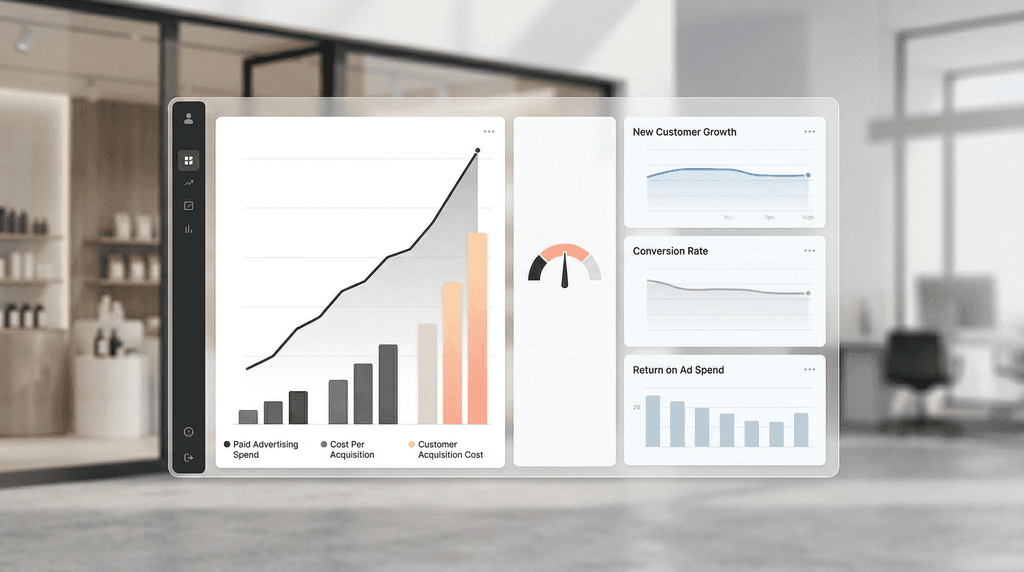
A D2C brand can spend more on ads and still grow less when acquisition costs rise faster than the store’s ability to convert, retain, and monetize customers. Shopify’s DTC marketing guidance notes that ad costs have increased sharply for small Shopify merchants, with Facebook impression costs rising 25% over one year and 100% over two years, which means brands can no longer rely on paid traffic alone. Growth now depends on a stronger relationship between acquisition, conversion, and retention.
Why this happens
The easy explanation is “ads got expensive,” but that is only half the story. The bigger problem is that many D2C brands keep scaling acquisition while the rest of the system stays weak. If landing pages do not convert well, product pages do not build trust, collections are hard to browse, or retention is poor, higher ad spend simply pushes more people into the same broken journey.
Shopify’s DTC marketing guidance is clear that brands need to diversify acquisition and extend customer lifetime value through retention channels like email, SMS, and direct messaging. In other words, growth gets harder when a brand depends too heavily on paid traffic and underinvests in owned channels and post-click performance.
How to fix it
1. Stop judging growth only by traffic volume
More traffic does not automatically mean better growth. If conversion is weak, paid traffic simply becomes more expensive waste. Merchant discussions on Shopify Community repeatedly show this pattern: traffic comes in, carts happen, but sales stay too low because the onsite experience is not strong enough.
2. Improve the store before scaling spend
If the site lacks trust, clear positioning, strong product pages, or a smooth checkout, more ad budget usually amplifies inefficiency. Shopify’s broader CRO and DTC guidance supports the idea that better usability and better conversion help brands get more from the traffic they already pay for.
3. Use retention to make acquisition more profitable
Shopify explicitly recommends extending customer lifetime value through retention channels like email, SMS, and direct messaging. If a brand is paying more to get each first purchase, the obvious next move is to make each customer worth more over time.
4. Diversify beyond one paid channel
If all growth depends on Meta or one ad source, rising costs hit harder. Shopify’s DTC guidance says the best brands diversify customer acquisition strategies rather than overdepend on one channel.
5. Strengthen owned-channel economics
One of the big advantages of D2C is better gross margin and better visibility into how capital is being spent. But that only works when the brand is actually using owned channels well — not just paying to recreate marketplace dependence through ads.
Real example
The VulgrCo case study is a strong example of what happens when a brand moves away from a system that keeps eating margin. On Amazon, the brand was losing margin to referral fees, FBA costs, and constant PPC pressure just to stay visible. On Shopify, the business could finally own the customer relationship, structure the catalog properly, surface its real value, and keep more of the money that had previously been leaking into platform costs. That is a useful D2C lesson: growth often improves not when ad spend increases, but when economics and conversion improve.
Common mistakes to avoid
A common mistake is trying to solve rising CAC only by improving creative or audience targeting. Those matter, but they do not fix a weak store or poor retention. Another mistake is treating paid acquisition as the whole business model instead of one input into a broader D2C system. Brands also often ignore the compounding value of owned channels, repeat purchase, and better merchandising.
Quick checklist
Are ad costs rising faster than revenue efficiency?
Is the store converting enough of paid traffic?
Do product pages build trust quickly?
Are cart abandonment and checkout friction under control?
Are email/SMS retention flows active?
Are returning customers buying again?
Are you too dependent on one paid channel?
Are you improving margin as well as traffic?
FAQs
Why can ad spend go up while growth slows down?
Because acquisition gets more expensive while conversion, retention, or margin stay weak. Paid traffic alone cannot carry the full business.
Is rising CAC the main problem for D2C brands?
It is a big problem, but usually not the only one. Weak store experience, poor retention, and overdependence on paid channels make rising CAC hurt even more.
What should brands fix first?
Usually the highest-leverage fixes are onsite conversion, trust, checkout, retention flows, and channel diversification before simply spending more.
Closing takeaway
If your D2C brand is spending more on ads but growing less, the answer is usually not “buy more traffic.” The answer is to make the traffic you already pay for more valuable through better conversion, stronger retention, and better owned-channel economics. That is what turns ad spend from a treadmill into a growth engine.
If rising ad costs are exposing weak conversion or retention, Flaxen can help tighten the storefront, improve the customer journey, and make paid traffic work harder before you scale spend again.
A D2C brand can spend more on ads and still grow less when acquisition costs rise faster than the store’s ability to convert, retain, and monetize customers. Shopify’s DTC marketing guidance notes that ad costs have increased sharply for small Shopify merchants, with Facebook impression costs rising 25% over one year and 100% over two years, which means brands can no longer rely on paid traffic alone. Growth now depends on a stronger relationship between acquisition, conversion, and retention.
Why this happens
The easy explanation is “ads got expensive,” but that is only half the story. The bigger problem is that many D2C brands keep scaling acquisition while the rest of the system stays weak. If landing pages do not convert well, product pages do not build trust, collections are hard to browse, or retention is poor, higher ad spend simply pushes more people into the same broken journey.
Shopify’s DTC marketing guidance is clear that brands need to diversify acquisition and extend customer lifetime value through retention channels like email, SMS, and direct messaging. In other words, growth gets harder when a brand depends too heavily on paid traffic and underinvests in owned channels and post-click performance.
How to fix it
1. Stop judging growth only by traffic volume
More traffic does not automatically mean better growth. If conversion is weak, paid traffic simply becomes more expensive waste. Merchant discussions on Shopify Community repeatedly show this pattern: traffic comes in, carts happen, but sales stay too low because the onsite experience is not strong enough.
2. Improve the store before scaling spend
If the site lacks trust, clear positioning, strong product pages, or a smooth checkout, more ad budget usually amplifies inefficiency. Shopify’s broader CRO and DTC guidance supports the idea that better usability and better conversion help brands get more from the traffic they already pay for.
3. Use retention to make acquisition more profitable
Shopify explicitly recommends extending customer lifetime value through retention channels like email, SMS, and direct messaging. If a brand is paying more to get each first purchase, the obvious next move is to make each customer worth more over time.
4. Diversify beyond one paid channel
If all growth depends on Meta or one ad source, rising costs hit harder. Shopify’s DTC guidance says the best brands diversify customer acquisition strategies rather than overdepend on one channel.
5. Strengthen owned-channel economics
One of the big advantages of D2C is better gross margin and better visibility into how capital is being spent. But that only works when the brand is actually using owned channels well — not just paying to recreate marketplace dependence through ads.
Real example
The VulgrCo case study is a strong example of what happens when a brand moves away from a system that keeps eating margin. On Amazon, the brand was losing margin to referral fees, FBA costs, and constant PPC pressure just to stay visible. On Shopify, the business could finally own the customer relationship, structure the catalog properly, surface its real value, and keep more of the money that had previously been leaking into platform costs. That is a useful D2C lesson: growth often improves not when ad spend increases, but when economics and conversion improve.
Common mistakes to avoid
A common mistake is trying to solve rising CAC only by improving creative or audience targeting. Those matter, but they do not fix a weak store or poor retention. Another mistake is treating paid acquisition as the whole business model instead of one input into a broader D2C system. Brands also often ignore the compounding value of owned channels, repeat purchase, and better merchandising.
Quick checklist
Are ad costs rising faster than revenue efficiency?
Is the store converting enough of paid traffic?
Do product pages build trust quickly?
Are cart abandonment and checkout friction under control?
Are email/SMS retention flows active?
Are returning customers buying again?
Are you too dependent on one paid channel?
Are you improving margin as well as traffic?
FAQs
Why can ad spend go up while growth slows down?
Because acquisition gets more expensive while conversion, retention, or margin stay weak. Paid traffic alone cannot carry the full business.
Is rising CAC the main problem for D2C brands?
It is a big problem, but usually not the only one. Weak store experience, poor retention, and overdependence on paid channels make rising CAC hurt even more.
What should brands fix first?
Usually the highest-leverage fixes are onsite conversion, trust, checkout, retention flows, and channel diversification before simply spending more.
Closing takeaway
If your D2C brand is spending more on ads but growing less, the answer is usually not “buy more traffic.” The answer is to make the traffic you already pay for more valuable through better conversion, stronger retention, and better owned-channel economics. That is what turns ad spend from a treadmill into a growth engine.
If rising ad costs are exposing weak conversion or retention, Flaxen can help tighten the storefront, improve the customer journey, and make paid traffic work harder before you scale spend again.
Other Blogs
Other Blogs
Check our other project Blogs with useful insight and information for your businesses


Other Blogs
Other Blogs
Check our other project Blogs with useful insight and information for your businesses