Our Three Step Process
January 20, 2026
How to Improve Shopify Conversion Rate Without Redesigning the Whole Store
Our Three Step Process
January 20, 2026
How to Improve Shopify Conversion Rate Without Redesigning the Whole Store
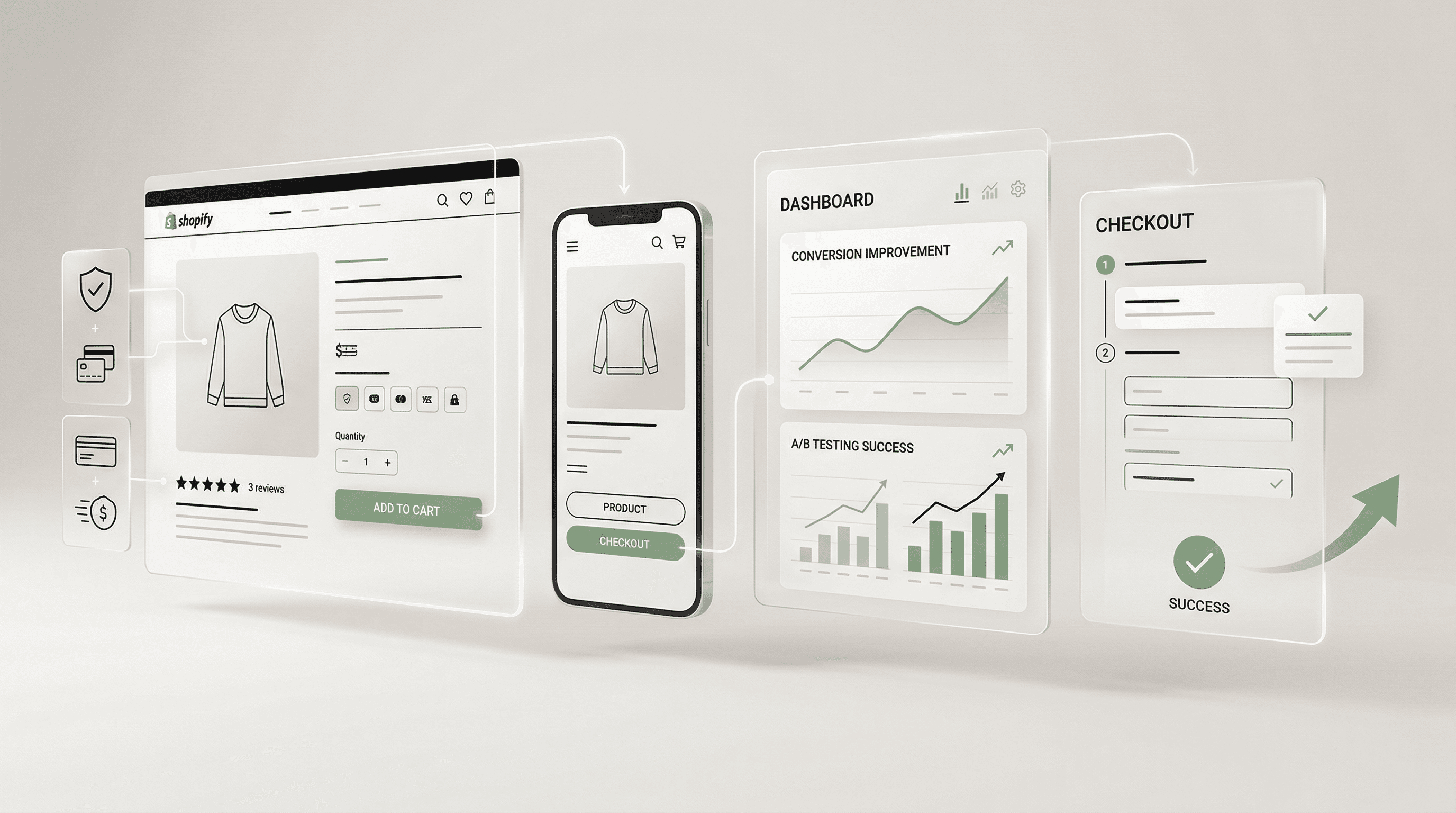
If your Shopify store is underperforming, you do not always need a full redesign to improve conversion rate. In many cases, the fastest gains come from reducing friction, clarifying the offer, improving trust, strengthening product pages, and fixing mobile and checkout issues. Conversion usually improves when the store becomes easier to understand and easier to buy from — not just when it looks newer.
Why this problem happens
A lot of D2C brands assume low conversion means the site needs a visual overhaul. But conversion problems often come from smaller operational issues: weak messaging, unclear product benefits, poor trust signals, confusing navigation, slow mobile performance, or friction in checkout. Shopify’s CRO guidance makes this clear: even small UX and checkout issues can stop people from completing a purchase.
This is why a redesign is not always the best first move. If the store already looks decent, changing the entire design may consume time and budget without fixing the real blockers. Often, the better approach is to audit the buying journey and improve the moments where confidence drops or effort rises. Shopify repeatedly emphasizes friction reduction, trust-building, and better decision support as conversion levers.
This also fits Flaxen’s positioning. Your own service page frames conversion as a result of better UX, clearer messaging, stronger objections handling, improved product structure, and better merchandising — not just a prettier interface. That is exactly the right angle for this article. Flaxen Media
How to fix it
1. Clarify the value proposition before changing the design
Before you touch layout, ask a simpler question: does the store clearly explain what the product is, who it is for, and why it is worth buying? If that message is weak, a redesign will not solve the real issue. Shopify recommends developing a strong value proposition because unclear positioning is one of the main reasons traffic fails to convert.
In practice, this means tightening:
homepage headline
product page first-screen copy
benefit-led product descriptions
offer clarity
differentiation from competitors
If visitors need too long to understand the product, conversion drops. Improving the message is often cheaper and faster than rebuilding the page.
2. Improve product pages where buying decisions actually happen
Many stores lose conversions because the product page does not do enough work. Shopify’s CRO guidance recommends making product pages more actionable through better visuals, stronger information, and less hesitation. If shoppers are not clicking Add to Cart, product-page friction is often the issue.
Simple upgrades can make a big difference:
better product images
clearer product benefits
trust-building microcopy
delivery and return info near the CTA
stronger reviews or testimonials
better variant selection UX
Your VulgrCo case study is a strong example of this principle. The conversion problem was not solved by “more design” alone — it was solved by creating a buying experience that matched how customers actually choose the product, including custom dimensions, materials, finishes, pricing logic, and uploads. Flaxen Media
3. Reduce buyer anxiety with stronger trust signals
A store can look polished and still feel risky. Shopify highlights trust-building as one of the most practical ways to improve conversion without rebuilding the entire experience. New shoppers often hesitate because they are unsure about product quality, delivery speed, returns, or whether the brand is legitimate.
Instead of redesigning the whole site, improve trust visibility:
add customer reviews near product CTAs
show delivery and returns clearly
surface guarantees
highlight payment security
include FAQ answers where hesitation happens
use social proof strategically
This aligns closely with your own service messaging. Flaxen already emphasizes that buyers arrive with objections, and the website has to answer those concerns before purchase. Flaxen Media
4. Fix mobile friction before changing the full layout
A lot of stores think the desktop design is the issue when the bigger problem is mobile usability. Shopify’s mobile UX guidance points out that non-intuitive navigation, hard-to-tap buttons, slow load time, and awkward checkout experiences can quickly turn interested visitors into lost sales.
You can often improve conversion without redesigning the entire store by fixing:
button size and spacing
menu clarity
sticky CTAs
page speed
image loading
mobile form friction
thumb-friendly checkout flow
If most of your traffic comes from Meta, TikTok, or Instagram, this matters even more because that traffic is overwhelmingly mobile-first.
5. Audit checkout friction and remove unnecessary steps
One of the highest-impact CRO improvements is often at checkout, not in the visual design layer. Shopify notes that cart abandonment remains a major issue, and even small checkout complications can push people away.
Before investing in a redesign, look for:
too many form fields
forced account creation
unclear shipping costs
limited payment options
slow checkout loading
weak mobile checkout usability
Shopify’s mobile UX recommendations also support this: make forms easier, use address autocomplete, and prioritize mobile-friendly payment options to reduce effort.
Common mistakes to avoid
One mistake is redesigning before diagnosing. If you do not know where conversion is leaking, a redesign becomes guesswork.
Another mistake is changing too many things at once. It becomes difficult to know what actually improved performance. CRO works better when you improve one layer at a time: product page clarity, trust, mobile usability, checkout, and navigation.
A third mistake is focusing only on aesthetics. A cleaner theme can help, but it will not fix poor value communication, missing reviews, or weak product structure. Shopify’s conversion guidance consistently points to friction reduction and trust-building as the bigger drivers.
And finally, some brands assume poor conversion means they need more traffic. In reality, improving the store experience often lifts revenue faster than simply paying for more visits.
Quick checklist
Use this before deciding you need a full redesign:
Is your value proposition clear in the first few seconds?
Do product pages explain benefits and objections clearly?
Are reviews or trust signals visible near conversion points?
Is shipping and returns information easy to find?
Does the site work smoothly on mobile?
Are buttons, menus, and forms easy to use on phones?
Is checkout fast and friction-light?
Are payment options familiar and convenient?
Have you checked session recordings or heatmaps before making changes?
Can you improve clarity, trust, or usability without changing the entire design?
FAQs
Can I improve Shopify conversion rate without redesigning my store?
Yes. Many conversion gains come from improving clarity, trust, mobile usability, product pages, and checkout rather than rebuilding the full design.
What should I optimize first?
Start with value proposition, product pages, trust signals, mobile UX, and checkout friction. Those are usually the fastest areas to improve.
How do I know whether I need optimization or a redesign?
If the store already looks credible but users still do not convert, the problem is often optimization. If the site is structurally broken, outdated, or hard to use across the whole experience, then a redesign may be justified.
Does mobile optimization really affect conversion that much?
Yes. Shopify specifically calls out mobile navigation, tap targets, load speed, and checkout usability as major conversion drivers.
What’s one of the biggest CRO wins without redesign?
Checkout simplification is one of the strongest candidates. Product-page trust improvements and better offer clarity are also high-impact without requiring a full site rebuild.
Closing takeaway
If your Shopify store is not converting well, a full redesign is not always the answer. In many cases, better conversion comes from making the current store clearer, easier, faster, and more trustworthy. For D2C brands, the biggest wins often come from fixing friction at the points where buyers hesitate — not from changing every visual element on the site. Shopify Flaxen Media
If your Shopify store is underperforming, you do not always need a full redesign to improve conversion rate. In many cases, the fastest gains come from reducing friction, clarifying the offer, improving trust, strengthening product pages, and fixing mobile and checkout issues. Conversion usually improves when the store becomes easier to understand and easier to buy from — not just when it looks newer.
Why this problem happens
A lot of D2C brands assume low conversion means the site needs a visual overhaul. But conversion problems often come from smaller operational issues: weak messaging, unclear product benefits, poor trust signals, confusing navigation, slow mobile performance, or friction in checkout. Shopify’s CRO guidance makes this clear: even small UX and checkout issues can stop people from completing a purchase.
This is why a redesign is not always the best first move. If the store already looks decent, changing the entire design may consume time and budget without fixing the real blockers. Often, the better approach is to audit the buying journey and improve the moments where confidence drops or effort rises. Shopify repeatedly emphasizes friction reduction, trust-building, and better decision support as conversion levers.
This also fits Flaxen’s positioning. Your own service page frames conversion as a result of better UX, clearer messaging, stronger objections handling, improved product structure, and better merchandising — not just a prettier interface. That is exactly the right angle for this article. Flaxen Media
How to fix it
1. Clarify the value proposition before changing the design
Before you touch layout, ask a simpler question: does the store clearly explain what the product is, who it is for, and why it is worth buying? If that message is weak, a redesign will not solve the real issue. Shopify recommends developing a strong value proposition because unclear positioning is one of the main reasons traffic fails to convert.
In practice, this means tightening:
homepage headline
product page first-screen copy
benefit-led product descriptions
offer clarity
differentiation from competitors
If visitors need too long to understand the product, conversion drops. Improving the message is often cheaper and faster than rebuilding the page.
2. Improve product pages where buying decisions actually happen
Many stores lose conversions because the product page does not do enough work. Shopify’s CRO guidance recommends making product pages more actionable through better visuals, stronger information, and less hesitation. If shoppers are not clicking Add to Cart, product-page friction is often the issue.
Simple upgrades can make a big difference:
better product images
clearer product benefits
trust-building microcopy
delivery and return info near the CTA
stronger reviews or testimonials
better variant selection UX
Your VulgrCo case study is a strong example of this principle. The conversion problem was not solved by “more design” alone — it was solved by creating a buying experience that matched how customers actually choose the product, including custom dimensions, materials, finishes, pricing logic, and uploads. Flaxen Media
3. Reduce buyer anxiety with stronger trust signals
A store can look polished and still feel risky. Shopify highlights trust-building as one of the most practical ways to improve conversion without rebuilding the entire experience. New shoppers often hesitate because they are unsure about product quality, delivery speed, returns, or whether the brand is legitimate.
Instead of redesigning the whole site, improve trust visibility:
add customer reviews near product CTAs
show delivery and returns clearly
surface guarantees
highlight payment security
include FAQ answers where hesitation happens
use social proof strategically
This aligns closely with your own service messaging. Flaxen already emphasizes that buyers arrive with objections, and the website has to answer those concerns before purchase. Flaxen Media
4. Fix mobile friction before changing the full layout
A lot of stores think the desktop design is the issue when the bigger problem is mobile usability. Shopify’s mobile UX guidance points out that non-intuitive navigation, hard-to-tap buttons, slow load time, and awkward checkout experiences can quickly turn interested visitors into lost sales.
You can often improve conversion without redesigning the entire store by fixing:
button size and spacing
menu clarity
sticky CTAs
page speed
image loading
mobile form friction
thumb-friendly checkout flow
If most of your traffic comes from Meta, TikTok, or Instagram, this matters even more because that traffic is overwhelmingly mobile-first.
5. Audit checkout friction and remove unnecessary steps
One of the highest-impact CRO improvements is often at checkout, not in the visual design layer. Shopify notes that cart abandonment remains a major issue, and even small checkout complications can push people away.
Before investing in a redesign, look for:
too many form fields
forced account creation
unclear shipping costs
limited payment options
slow checkout loading
weak mobile checkout usability
Shopify’s mobile UX recommendations also support this: make forms easier, use address autocomplete, and prioritize mobile-friendly payment options to reduce effort.
Common mistakes to avoid
One mistake is redesigning before diagnosing. If you do not know where conversion is leaking, a redesign becomes guesswork.
Another mistake is changing too many things at once. It becomes difficult to know what actually improved performance. CRO works better when you improve one layer at a time: product page clarity, trust, mobile usability, checkout, and navigation.
A third mistake is focusing only on aesthetics. A cleaner theme can help, but it will not fix poor value communication, missing reviews, or weak product structure. Shopify’s conversion guidance consistently points to friction reduction and trust-building as the bigger drivers.
And finally, some brands assume poor conversion means they need more traffic. In reality, improving the store experience often lifts revenue faster than simply paying for more visits.
Quick checklist
Use this before deciding you need a full redesign:
Is your value proposition clear in the first few seconds?
Do product pages explain benefits and objections clearly?
Are reviews or trust signals visible near conversion points?
Is shipping and returns information easy to find?
Does the site work smoothly on mobile?
Are buttons, menus, and forms easy to use on phones?
Is checkout fast and friction-light?
Are payment options familiar and convenient?
Have you checked session recordings or heatmaps before making changes?
Can you improve clarity, trust, or usability without changing the entire design?
FAQs
Can I improve Shopify conversion rate without redesigning my store?
Yes. Many conversion gains come from improving clarity, trust, mobile usability, product pages, and checkout rather than rebuilding the full design.
What should I optimize first?
Start with value proposition, product pages, trust signals, mobile UX, and checkout friction. Those are usually the fastest areas to improve.
How do I know whether I need optimization or a redesign?
If the store already looks credible but users still do not convert, the problem is often optimization. If the site is structurally broken, outdated, or hard to use across the whole experience, then a redesign may be justified.
Does mobile optimization really affect conversion that much?
Yes. Shopify specifically calls out mobile navigation, tap targets, load speed, and checkout usability as major conversion drivers.
What’s one of the biggest CRO wins without redesign?
Checkout simplification is one of the strongest candidates. Product-page trust improvements and better offer clarity are also high-impact without requiring a full site rebuild.
Closing takeaway
If your Shopify store is not converting well, a full redesign is not always the answer. In many cases, better conversion comes from making the current store clearer, easier, faster, and more trustworthy. For D2C brands, the biggest wins often come from fixing friction at the points where buyers hesitate — not from changing every visual element on the site. Shopify Flaxen Media
Other Blogs
Other Blogs
Check our other project Blogs with useful insight and information for your businesses

Other Blogs
Other Blogs
Check our other project Blogs with useful insight and information for your businesses