Our Three Step Process
February 28, 2026
How D2C Brands Should Organize Products, Collections, and Bundles
Our Three Step Process
February 28, 2026
How D2C Brands Should Organize Products, Collections, and Bundles
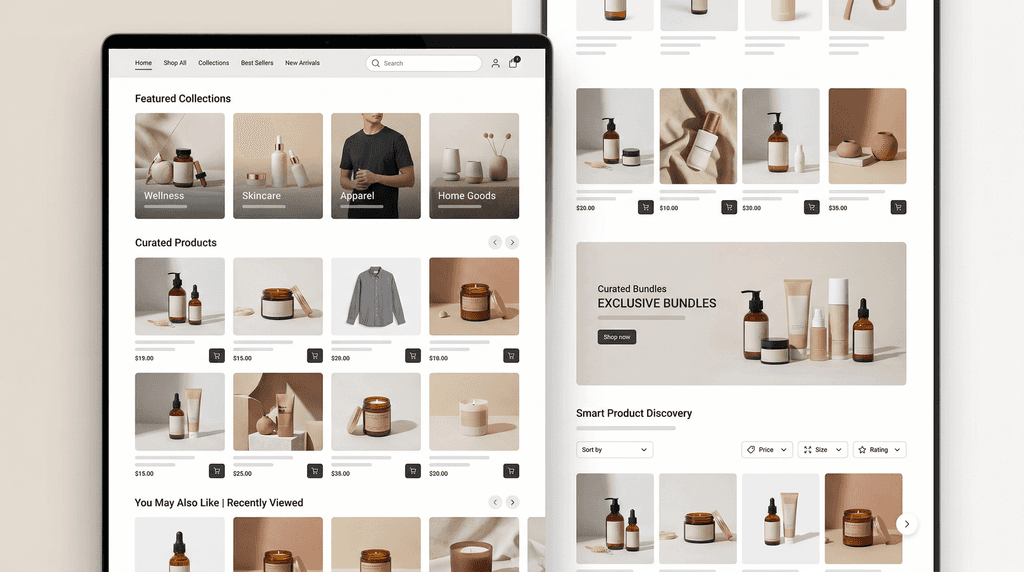
D2C brands should organize products around how customers shop, not how the internal team thinks about inventory. That means clean product architecture, collections built around shopper intent, and bundles that increase discovery and average order value without creating confusion. Shopify’s bundling guidance highlights mixed bundles, cross-sell bundles, upsell bundles, and build-your-own options as practical ways to improve the shopping experience and grow basket size.
Why this problem happens
As a catalog grows, many stores become harder to shop. Products are added over time, collections multiply, bundles appear as one-off promotions, and the site starts reflecting backend operations instead of customer behavior. The result is clutter: too many products, weak category logic, poor discovery, and missed cross-sell opportunities. Bundles then get layered on top without a clear structure, which adds even more noise. Shopify’s guidance on bundling makes the opposite case: product grouping should help customers buy more easily, discover complementary products, and understand value faster.
How to fix it
1. Start with a clear product hierarchy
Your catalog should make sense in seconds. Customers should be able to understand product types, key differences, and natural entry points into the store. Product architecture needs to support both browsing and search. If a shopper lands on one product, the site should make related products obvious.
2. Build collections around shopping intent
Good collections reflect how buyers think: by use case, product type, problem, benefit, audience, or occasion. They should not feel like internal stock lists. A wellness brand might group by “Daily Energy,” “Sleep Support,” or “Starter Kits.” A fashion or print brand might group by “Best Sellers,” “New Arrivals,” or “Business Packaging.” The goal is to reduce friction and support discovery.
3. Use bundles as merchandising, not just discounting
Shopify highlights several useful bundle types, including mixed bundles, cross-sell bundles, upsell bundles, subscription bundles, and build-your-own bundles. The point is not just to force items together. The point is to help customers buy related products more naturally while increasing order value.
4. Match bundle type to the job
Not every bundle should work the same way. Shopify’s guidance points to several practical models:
mixed bundles for complementary products
cross-sell bundles for natural add-ons
upsell bundles for premium versions
gift bundles for occasions
build-your-own bundles for personalization
subscription bundles for repeat-use products
5. Make inventory and merchandising support the structure
Collections and bundles only work well if inventory, product data, and store logic are clean. Shopify emphasizes real-time bundle inventory support through Shopify Bundles and recommends using sales and inventory data to decide which items belong together.
Real example
Your VulgrCo case study is a strong example of this. On Amazon, the catalog existed as disconnected listings. On Shopify, the products were reorganized into clear collections like Custom Stickers, Custom Labels, DTF Transfers, Wall & Floor Decals, and Custom Skateboards. That structure turned a scattered product set into a discoverable storefront where customers could naturally explore adjacent products and cross-sell opportunities.
A second useful lesson comes from Black Gold Elixir, where the catalog and inventory structure had to be cleaned up so what was live on the site actually matched what the brand could fulfill. That’s an important reminder: merchandising starts with operational accuracy.
Common mistakes to avoid
One mistake is creating too many collections with overlapping purposes. Another is burying core products inside unclear category structures. Brands also often create bundles that only make sense internally, not to shoppers. And a big one: using bundles purely to push discounts instead of improving product discovery or purchase logic. Shopify’s bundling guidance works best when bundles add convenience and relevance, not just price pressure.
Quick checklist
Can a first-time shopper understand the main product categories fast?
Are collections based on customer intent or internal operations?
Are best sellers and starter paths easy to find?
Do related products naturally connect to each other?
Are bundles built around convenience, value, or use case?
Do bundle offers fit the product logic?
Is inventory clean enough to support merchandising confidently?
Are collection pages helping users discover more, not less?
FAQs
What is the best bundle type for D2C brands?
It depends on the catalog, but mixed bundles, cross-sell bundles, and build-your-own bundles are often practical because they increase convenience and average order value without forcing rigid buying behavior.
Should collections be built by product type or by customer use case?
Usually both, but the customer should always win. If use-case collections make buying easier, prioritize them alongside clean product-type navigation.
Are bundles mainly for increasing AOV?
That’s one benefit, but Shopify also points out that bundles help with product discovery, loyalty, brand differentiation, and moving slower inventory.
Closing takeaway
Great D2C stores are easy to shop because the store structure reflects customer intent. When products, collections, and bundles are organized well, shoppers discover more, trust the site faster, and build bigger baskets with less effort.
If your store feels hard to browse, hard to merchandise, or difficult to scale, Flaxen can help restructure products, collections, and bundles so the storefront supports both conversion and long-term growth. Source
D2C brands should organize products around how customers shop, not how the internal team thinks about inventory. That means clean product architecture, collections built around shopper intent, and bundles that increase discovery and average order value without creating confusion. Shopify’s bundling guidance highlights mixed bundles, cross-sell bundles, upsell bundles, and build-your-own options as practical ways to improve the shopping experience and grow basket size.
Why this problem happens
As a catalog grows, many stores become harder to shop. Products are added over time, collections multiply, bundles appear as one-off promotions, and the site starts reflecting backend operations instead of customer behavior. The result is clutter: too many products, weak category logic, poor discovery, and missed cross-sell opportunities. Bundles then get layered on top without a clear structure, which adds even more noise. Shopify’s guidance on bundling makes the opposite case: product grouping should help customers buy more easily, discover complementary products, and understand value faster.
How to fix it
1. Start with a clear product hierarchy
Your catalog should make sense in seconds. Customers should be able to understand product types, key differences, and natural entry points into the store. Product architecture needs to support both browsing and search. If a shopper lands on one product, the site should make related products obvious.
2. Build collections around shopping intent
Good collections reflect how buyers think: by use case, product type, problem, benefit, audience, or occasion. They should not feel like internal stock lists. A wellness brand might group by “Daily Energy,” “Sleep Support,” or “Starter Kits.” A fashion or print brand might group by “Best Sellers,” “New Arrivals,” or “Business Packaging.” The goal is to reduce friction and support discovery.
3. Use bundles as merchandising, not just discounting
Shopify highlights several useful bundle types, including mixed bundles, cross-sell bundles, upsell bundles, subscription bundles, and build-your-own bundles. The point is not just to force items together. The point is to help customers buy related products more naturally while increasing order value.
4. Match bundle type to the job
Not every bundle should work the same way. Shopify’s guidance points to several practical models:
mixed bundles for complementary products
cross-sell bundles for natural add-ons
upsell bundles for premium versions
gift bundles for occasions
build-your-own bundles for personalization
subscription bundles for repeat-use products
5. Make inventory and merchandising support the structure
Collections and bundles only work well if inventory, product data, and store logic are clean. Shopify emphasizes real-time bundle inventory support through Shopify Bundles and recommends using sales and inventory data to decide which items belong together.
Real example
Your VulgrCo case study is a strong example of this. On Amazon, the catalog existed as disconnected listings. On Shopify, the products were reorganized into clear collections like Custom Stickers, Custom Labels, DTF Transfers, Wall & Floor Decals, and Custom Skateboards. That structure turned a scattered product set into a discoverable storefront where customers could naturally explore adjacent products and cross-sell opportunities.
A second useful lesson comes from Black Gold Elixir, where the catalog and inventory structure had to be cleaned up so what was live on the site actually matched what the brand could fulfill. That’s an important reminder: merchandising starts with operational accuracy.
Common mistakes to avoid
One mistake is creating too many collections with overlapping purposes. Another is burying core products inside unclear category structures. Brands also often create bundles that only make sense internally, not to shoppers. And a big one: using bundles purely to push discounts instead of improving product discovery or purchase logic. Shopify’s bundling guidance works best when bundles add convenience and relevance, not just price pressure.
Quick checklist
Can a first-time shopper understand the main product categories fast?
Are collections based on customer intent or internal operations?
Are best sellers and starter paths easy to find?
Do related products naturally connect to each other?
Are bundles built around convenience, value, or use case?
Do bundle offers fit the product logic?
Is inventory clean enough to support merchandising confidently?
Are collection pages helping users discover more, not less?
FAQs
What is the best bundle type for D2C brands?
It depends on the catalog, but mixed bundles, cross-sell bundles, and build-your-own bundles are often practical because they increase convenience and average order value without forcing rigid buying behavior.
Should collections be built by product type or by customer use case?
Usually both, but the customer should always win. If use-case collections make buying easier, prioritize them alongside clean product-type navigation.
Are bundles mainly for increasing AOV?
That’s one benefit, but Shopify also points out that bundles help with product discovery, loyalty, brand differentiation, and moving slower inventory.
Closing takeaway
Great D2C stores are easy to shop because the store structure reflects customer intent. When products, collections, and bundles are organized well, shoppers discover more, trust the site faster, and build bigger baskets with less effort.
If your store feels hard to browse, hard to merchandise, or difficult to scale, Flaxen can help restructure products, collections, and bundles so the storefront supports both conversion and long-term growth. Source
Other Blogs
Other Blogs
Check our other project Blogs with useful insight and information for your businesses

Other Blogs
Other Blogs
Check our other project Blogs with useful insight and information for your businesses